
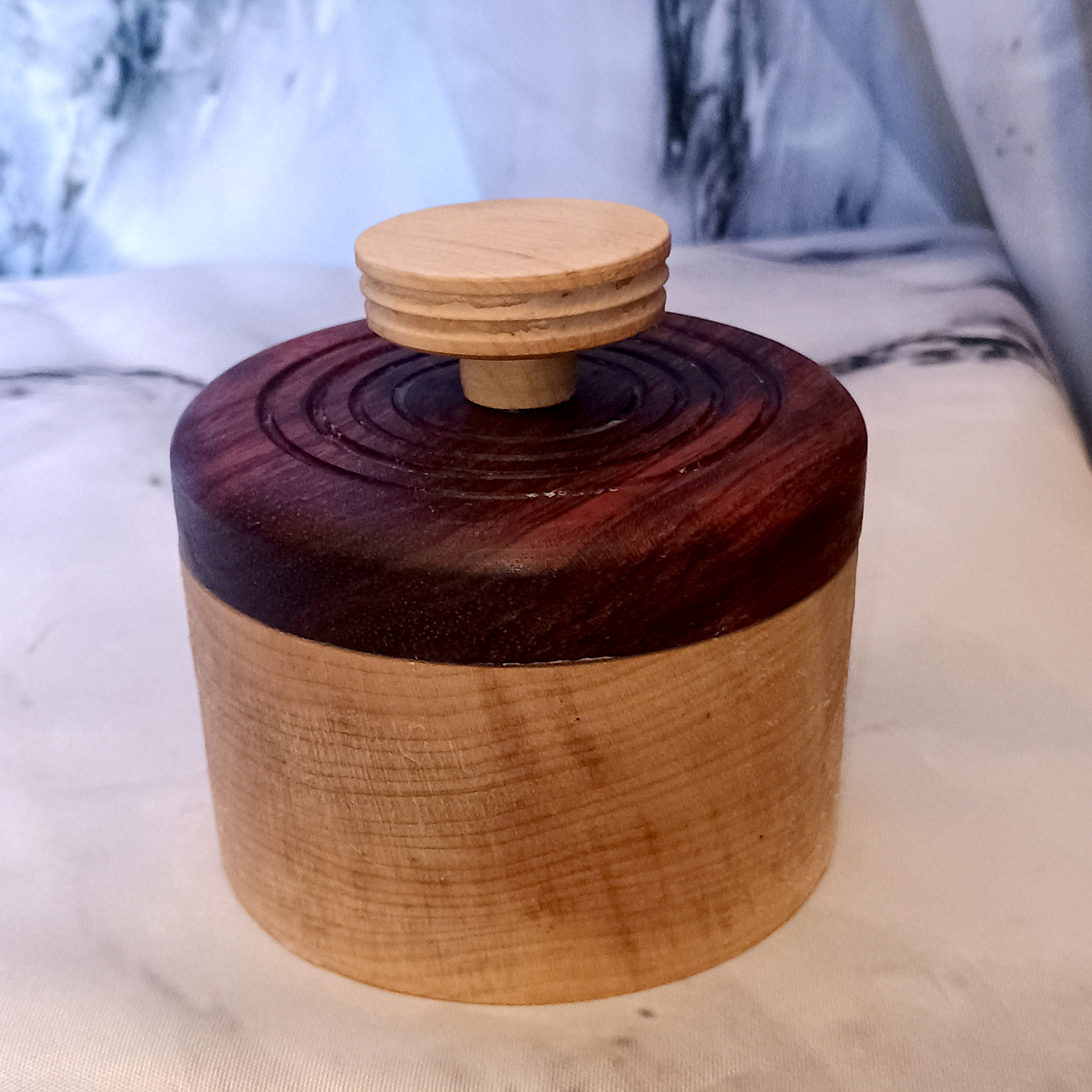
Both are beloved American hardwoods. Both are food-safe. Both are beautiful. So which one should you choose for a cutting board, spoon, or spatula?
By the end of this post, you’ll know exactly which one to reach for — and honestly, it depends on what you’re making.
Quick Comparison at a Glance
| Walnut | Maple | |
|---|---|---|
| Color | Darker, rich chocolate tones | Lighter, creamy |
| Hardness | Softer (relatively) | Harder |
| Grain | Open, dramatic figure | Tight, closed |
| Best For | Carving, beauty, serving pieces | Heavy-use cutting surfaces |
Cutting Boards: Maple Wins
Maple’s tight grain resists moisture absorption and bacterial harboring — exactly what you want on a surface that meets a knife every day. That same hardness means it holds up to blade edges far longer than a softer wood would. Our Ambrosia Maple Lichtenburg Cutting Boards show off maple’s durability without sacrificing beauty — the natural beetle-track grain gives every board its own one-of-a-kind pattern.
Walnut is lovely on a board, but it scratches more visibly under regular use. It shines as a serving board rather than a heavy-duty prep board, like our Handcrafted Cheese & Cracker Boards in rich walnut.
Can’t decide? Our Walnut & Maple End Grain Checkerboard Cutting Board gives you the best of both in one heirloom piece.
Spoons and Carving: Walnut Wins on Beauty, Maple on Durability
Walnut is a joy to carve. It’s slightly softer than maple, so it works with the carving tool rather than against it — and the color only gets better with age. Walnut darkens and mellows over time, developing a warmth that’s hard to replicate in any other wood. It’s no accident that walnut is a signature material in Sar’s hand-carved spoons, from our small spoons under 6″ to statement pieces over 10″ and our hand-carved Welsh love spoons.
Maple spoons, on the other hand, are incredibly durable but tougher to hand-carve, which is part of why you’ll see maple more often in production work than in one-of-a-kind carved pieces.
Spatulas, Paddles, and Stirrers
Either wood works beautifully here — the choice really comes down to aesthetics. One practical note: maple’s lighter color will show staining more visibly over time, while walnut’s darker tone hides it gracefully. Our Mix & Match Walnut & Maple Wine Set and Maple & Walnut Salt & Pepper Mill are great examples of how naturally these two woods pair on the table.
Food Safety: Both Are Excellent
Walnut and maple are both non-toxic and fully food-safe when properly finished. Both benefit from regular conditioning with a food-grade oil, like mineral oil, or a beeswax finish, to keep them looking and performing their best for years.
The Bottom Line
- Maple — best for high-use cutting surfaces
- Walnut — best for carving, beauty, and pieces that age gracefully
- Both — perfect for gifting, either way
When people talk about kitchen-ready, food-safe, American-made hardwoods, walnut and maple are always the first two names that come up. There are many varieties of each, but they share one thing in common: they look incredible in a kitchen. Mix them in the same piece and the contrast only adds to the beauty — like our Salt & Pepper Shakers in Walnut & Maple or the Ball Bearing Rolling Pin in Maple & Walnut. For a cutting board, maple wins on durability — but for hand-carved utensils, walnut wins on warmth and color. Either way, you’re getting a food-safe piece built to last.
Shop the Collection: Browse all of our Kitchen & Bar pieces or see everything we make in the full shop.
A Closer Look: The Wood Species Behind the Comparison
“Walnut” and “maple” aren’t single woods — they’re families, each with several distinct species that bring their own character to a finished piece.
Maple, Typically
Most maple you’ll encounter in a kitchen shares a few traits: a pale, creamy color, a tight and even grain, and serious durability. It’s dense, resists moisture well, and takes a smooth polish — which is exactly why it’s the wood of choice for cutting boards and rolling pins. But “maple” covers a surprising range of species, each with its own personality:
Hard (Sugar) Maple (Acer saccharum) — The classic choice for cutting boards and butcher blocks, prized for being the densest and most durable of the maples. It’s also the source of maple syrup, and select logs produce the prized “birdseye” figure woodworkers love.
Red Maple (Acer rubrum) — One of the most widespread maples in North America, with a closed grain similar enough to hard maple that it’s often used as a substitute in furniture and turned pieces.
Silver Maple (Acer saccharinum) — A softer, easy-working maple with a fine, even texture and color that ranges from pale cream to golden tones with reddish streaks. It turns, glues, and finishes easily, though it can scorch under high-speed tools.
Big Leaf Maple (Acer macrophyllum) — A Pacific Northwest native known for dramatic figure and burl, with colors ranging from white to coral pink. Slightly harder to work than Eastern maples, but the payoff in beauty is worth it.
Ambrosia Maple — Not a separate species at all, but ordinary maple (most often soft maple) marked by tiny ambrosia beetles that tunnel through the wood while it’s still standing. The beetles carry a fungus that stains the surrounding wood in flowing gray, blue, or brown streaks, with small pinholes tracing their path. The result is a one-of-a-kind, almost watercolor-like pattern that’s become a favorite for statement pieces, serving boards, and turned items — our Ambrosia Maple Lichtenburg Cutting Boards are a great example.
Walnut, Typically
Walnut, as a family, tends to run darker and richer than maple — warm chocolate-brown tones, a more open grain, and a softness that makes it a favorite for carving. It ages beautifully, deepening in color over time, and it’s what gives Sar’s hand-carved spoons their signature look. Here, too, there’s more variety than people expect:
American Black Walnut (Juglans nigra) — The classic U.S. walnut and a mainstay of American furniture-making for generations. Easy to mill, glue, and finish, with a warm, moderate luster.
Claro Walnut (Juglans hindsii) — A Pacific Coast native prized for rich color and dramatic figure that goes well beyond typical Eastern walnut. Much of the supply comes from retired walnut orchards, giving old trees a second life as fine furniture and turned pieces.
English Walnut (Juglans regia) — The original walnut of Europe, with color that varies by climate and soil. Despite its name meaning “white walnut,” the dark striping people associate with walnut is actually the exception rather than the rule in this species.
Bastogne Walnut — A naturally occurring hybrid of Claro and English Walnut, nicknamed “Paradox Walnut” for growing faster than either parent while yielding stronger, harder lumber with strikingly beautiful figure.
Peruvian Walnut (Juglans neotropica) — A South American species with a deep chocolate-brown color, sometimes with a purplish hue and lighter streaks running through the heartwood. Slightly coarser-grained than its North American and European cousins.
Every piece in our shop starts with wood like this — chosen for its character as much as its performance. Explore the full Kitchen & Bar collection to see how each species comes to life in a finished piece.


0 Comments